Plan articles around the questions readers type
Editors and writers can start from what readers already ask. Keyfern returns the question, comparison and long-tail phrases for a topic, grouped by cluster, so each cluster can become an article and its questions become sections or FAQs.
How publishing teams use Keyfern
- Enter the beat or topic as a seed; keep question and preposition expansion on.
- Group by cluster; each cluster is an article candidate.
- Use question phrases as subheadings and FAQ entries.
- Schedule monitor mode weekly to get only new phrases as they appear.
YouTube phrasing is included, which helps when a story also gets a video.
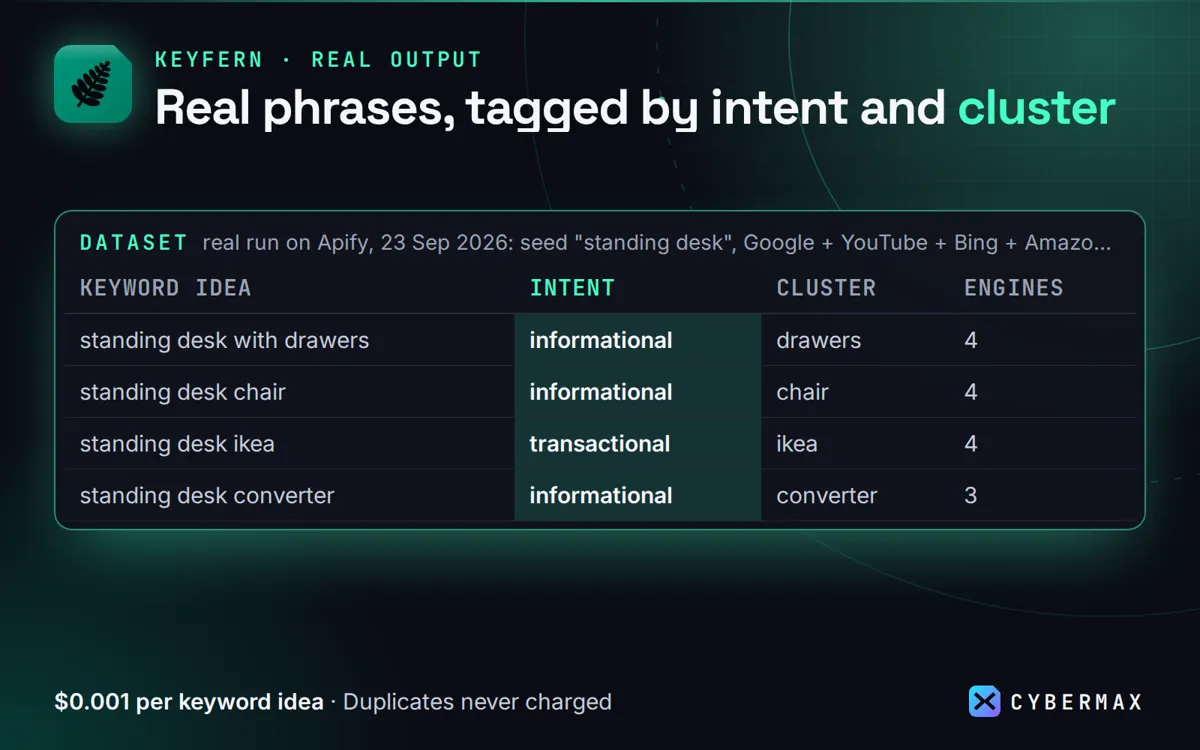
Real run on Apify, 23 Sep 2026: seed "standing desk", Google + YouTube + Bing + Amazon, US
| Keyword idea | Intent | Cluster | Engines | Score | Google Trends |
|---|---|---|---|---|---|
| standing desk with drawers | informational | drawers | 4 | 100 | rising +111% |
| standing desk chair | informational | chair | 4 | 100 | rising +74% |
| standing desk ikea | transactional | ikea | 4 | 100 | stable +13.5% |
| standing desk converter | informational | converter | 3 | 90 | – |
| standing desk and walking pad | informational | walking | 4 | 90 | – |
Source: products/keyword-ideas/store/listing.json (real run of Keyfern on Apify, 23 Sep 2026).
FAQ
How many ideas does one seed give?
Up to 300 per seed by default; you can change the limit.
Why not just use Google's suggestions?
You see about ten at a time. Keyfern runs dozens of expansions across engines and dedupes them.
Keyfern: full guide with prices and alternatives · All use cases · Store