A credit card and loan payoff plan your household can follow
Most households carry several cards and a loan or two, each with a different APR and minimum. Debtfell puts them on one sheet and shows what an extra payment does: which debt goes first, when each one is gone and how much interest you avoid.
How consumer finance teams use Debtfell
- Collect the latest statement for every card and loan: balance, APR and minimum payment.
- Enter them on the Debts tab; agree as a household on one extra monthly amount you can keep paying.
- Compare snowball and avalanche on the Dashboard and pick the one you will stick with.
- Each month, log the payments and new balances on the Tracker and watch the progress bar.
In the worked example, six debts totalling over $22,000 with $300 extra a month are cleared in 27 months instead of 59 on minimums only, saving $3,592 in interest with the avalanche method.
The file is for your own household (personal licence) and works on any of your devices; share it with your partner in Google Sheets.
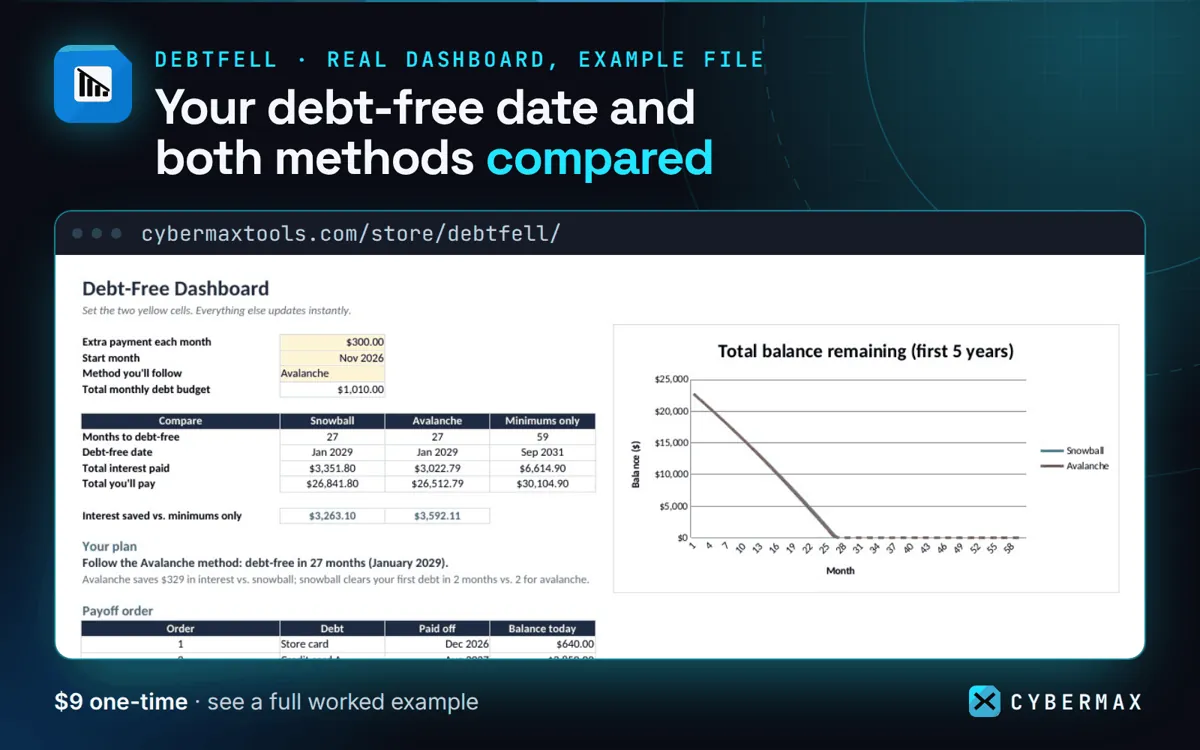
Worked example in the file: 6 debts, $300 extra a month, avalanche order
| Debt | Balance | APR | Paid off (avalanche) |
|---|---|---|---|
| Store card | $640 | 26.99% | Dec 2026 |
| Credit card A | $2,850 | 22.49% | Aug 2027 |
| Credit card B | $5,300 | 18.99% | May 2028 |
| Personal loan | $4,100 | 11.49% | Aug 2028 |
| Car loan | $9,400 | 6.79% | Jan 2029 |
Source: The made-up worked example that ships in the Debtfell example file (built by products/debtfell/src/workbook.py, listed in products/debtfell/store/listing.json); the sixth debt is on the Debts tab.
FAQ
Should we close cards as we pay them off?
Debtfell does not decide that; it keeps the paid-off card at zero in the plan. Ask your lender or a credit counsellor about closing accounts.
Why not a budgeting app?
Apps track spending; Debtfell answers one question well: when will we be debt-free, and what does each extra dollar save. It is a one-time $9 file.
Debtfell: full guide with prices and alternatives · All use cases · Store